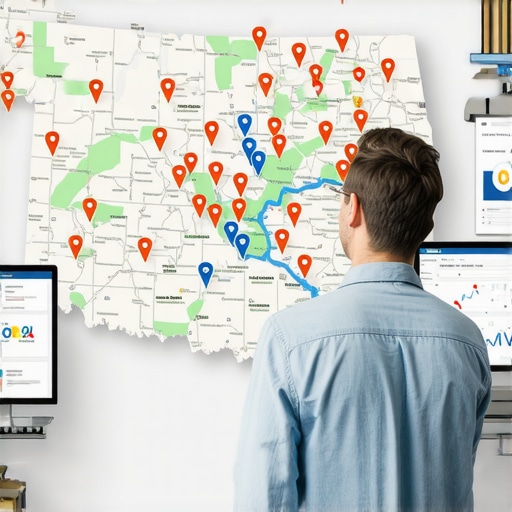
Last year, I hit a wall with my local Oklahoma business. No matter what I tried, my Google Maps listing just wouldn’t climb higher than a few scattered spots on the local search results. I remember sitting at my desk, frustration bubbling up, thinking, “Why is everyone else ranking better?” It was a lightbulb moment—there must be a missing piece in my SEO puzzle. That realization led me on a journey to uncover proven Google Maps ranking strategies tailored for Oklahoma businesses, especially as 2024 gears up with new challenges and opportunities.
Why Local SEO in Oklahoma Matters More Than Ever
In today’s competitive local landscape, simply having a website isn’t enough. Customers are searching for services nearby, and Google Maps is often their first stop. If your business isn’t appearing prominently on the map, you’re missing out on countless potential clients. According to recent studies, 78% of local mobile searches result in an offline purchase, emphasizing how vital Google Maps visibility really is. But here’s the catch—many business owners are unknowingly making mistakes that keep them buried in the rankings.
Are Google Maps Strategies Overhyped? Think Again.
Early on, I wasted months pouring time into generic SEO tactics that didn’t move the needle on Google Maps. I believed optimizing my website alone would suffice. Spoiler: It didn’t. I also overlooked the importance of consistent NAP (Name, Address, Phone Number) across directories and neglected to gather enough genuine reviews. These small missteps caused my rankings to stagnate. Now, I know better. Effective local SEO, especially in Oklahoma City and surrounding areas, requires a targeted approach that combines multiple proven tactics. Curious to see what actually works? I’ll share the strategies that helped me elevate my Google Maps rankings and how you can apply them. For a detailed blueprint, check out [this comprehensive guide](https://oklahomacityseoservices.com/top-okc-google-maps-optimization-tips-for-local-business-success-in-2024). If you’ve faced similar frustrations, read on—I’m about to reveal the step-by-step approach that turned my local visibility around, and it can do the same for you.
Optimize Your Business NAP Consistency
When I first tackled my Oklahoma City listing, I quickly realized that inconsistent business details across directories sabotage rankings. Think of your NAP (Name, Address, Phone Number) like the foundation of a building—you need all pieces aligned. I dedicated a morning to audit every online mention of my business, updating and standardizing NAP details everywhere from Yelp to local chambers. This shift resulted in a noticeable bump in local map rankings within weeks. To streamline this, use tools like Moz Local or BrightLocal to identify inconsistencies and correct them systematically. For detailed steps, check out this guide.
Build and Gathering Authentic Reviews
Reviews are social proof stamped with Google’s stamp of approval. I recall reaching out to satisfied customers with personalized requests for reviews. It’s like planting seeds; the more genuine reviews you gather, the higher your visibility grows. Remember, reviews not only influence rankings but also sway potential clients. I found that responding to existing reviews, whether positive or negative, boosts engagement and signals activity to Google. Aim to receive at least five new reviews weekly, focusing on quality over quantity. Consider creating a simple script for review requests or leveraging review generation tools to keep the process consistent. For more insights, see this resource.
Refine Your Local Keyword Strategy
Keyword optimization is more than stuffing phrases; it’s about relevance and intent. I used a local keyword research tool to identify phrases my Oklahoma customers search for, like “best BBQ in OKC” or “Oklahoma city plumbers.” Then, I incorporated these into my Google My Business description, website meta tags, and service pages. It’s like tuning a radio to catch the right signal—the clearer the tune, the stronger the connection. Regularly monitor keyword performance with tools like SEMrush or Ahrefs, adjusting as search behaviors evolve. For a comprehensive approach, explore this guide.
Leverage Local Backlinks and Citations
Backlinks from reputable local sources act as endorsements. I co-hosted a community event and secured local press coverage, earning a backlink that bolstered my map position. Similar to word-of-mouth recommendations, backlinks signal authority to Google. Focus on building relationships with Oklahoma bloggers, chambers of commerce, and local associations. Ensure citations of your business are consistent and accurate on industry-specific directories. This layered approach enhances your company’s credibility and visibility. To master this, review this expert advice.
Maintain Active Engagement and Regular Updates
Google favors active and engaged listings—think of it as maintaining your storefront’s reputation. I started posting weekly updates about new services, promotions, or community involvement directly on my Google My Business profile. These updates appear in local searches, increasing touchpoints with potential customers. Additionally, respond promptly to questions and comments. I set calendar reminders to review my profile every week, ensuring freshness. This ongoing activity signals to Google that my business is vibrant and trustworthy. For ongoing tips, visit this resource.
Many assume that local SEO in Oklahoma is mainly about keyword stuffing and basic directory listings, but the truth runs much deeper. A common myth is that once you optimize your Google My Business profile and gather reviews, your local rankings will automatically soar. However, this overlooks the importance of nuanced strategies like entity optimization and local link authority, which experts emphasize are critical for sustained growth. Relying solely on superficial tactics can lead to what I call the ‘local SEO plateau,’ where rankings stagnate despite ongoing efforts. The real challenge is understanding these hidden nuances and integrating them into your overall strategy, which is often overlooked by service providers offering generic solutions.
One crucial mistake I see many Oklahoma business owners make is neglecting the technical integrity of their website in relation to local signals. For instance, inconsistent schema markup or poor site speed can undermine your Google Maps ranking efforts. Ensure your website is optimized for both user experience and search engines—factors that advanced SEO practitioners focus on when aiming for top local results.
Now, for the advanced readers asking: “How can I leverage latent local signals to outperform my competitors?” — the answer lies in building a robust local backlink profile and understanding Google’s local algorithm intricacies. Backlinks from reputable Oklahoma-based sources, such as local chambers or industry associations, act as strong endorsements. These aren’t just vanity metrics; studies from Moz indicate that local link authority significantly affects local pack visibility. To get ahead, you need to craft an outreach strategy tailored to Oklahoma’s unique business ecosystem, focusing on quality over quantity.
Furthermore, maintaining an active and engaged profile on Google Maps goes beyond periodic updates. Regularly analyzing your competitors’ tactics and adjusting your local SEO campaigns accordingly can make a formidable difference. This involves monitoring your map rankings with tools like BrightLocal or SEMrush and refining your approach based on these insights.
Avoid falling into the trap of shallow tactics that seem quick but don’t build long-term value. For example, adding keyword-rich content on your profile without aligning it with your overall local branding can backfire. Instead, invest in authoritative local citations and community engagement—these actions signal relevance and trustworthiness to Google.
Lastly, do not underestimate the power of comprehensive, tailored strategies. For instance, a holistic approach that integrates Google Maps optimization, local SEO content marketing, and reputation management consistently outperforms piecemeal efforts. For practical application, check out this guide for a detailed blueprint.
Have you ever fallen into this trap? Let me know in the comments. The key takeaway here is that truly mastering Oklahoma SEO and Google Maps rankings requires attention to intricate details that many overlook—focusing on these nuances can exponentially increase your local visibility and growth.Once you’ve laid a solid foundation for your local SEO in Oklahoma, keeping it effective over time demands consistent monitoring and fine-tuning. I rely on several specialized tools that help me track, analyze, and improve my Google Maps rankings continually. Using BrightLocal, for example, I’ve gained precise insights into my local search performance and citation consistency. Its local rank tracker allows me to observe fluctuations in my OKC maps ranking day-to-day, making it easy to spot when a tweak is needed. Additionally, Moz Local is invaluable for auditing and correcting NAP inconsistencies across numerous directories, thus preventing ranking dips caused by outdated information. These tools provide me with actionable data, enabling quick responses to ranking changes and ensuring long-term results. As local search algorithms evolve—probably incorporating more AI-driven signals—my strategy is to leverage these tools to stay ahead, adjusting my tactics based on real-time insights. In the future, I predict that integration of voice search analytics and AI-powered local signal analysis will become essential, making data-driven adjustments even more critical for local businesses aiming to outrank competitors.
How do I maintain steady Google Maps results over time?
Regular audits and updates are key. Schedule monthly checks on your citation accuracy using Moz Local, and keep an eye on your Google My Business performance with BrightLocal’s rank tracking. Respond promptly to reviews, continue creating relevant local content, and monitor your competitors’ activity for cues. Remember, automation is your friend here—set up alerts for significant ranking shifts and citation issues. I’ve found that a disciplined, data-driven approach keeps my Oklahoma SEO strategy resilient against algorithm changes and competitive pressures. For an integrated approach combining these techniques, I recommend reviewing this comprehensive guide. Ready to give your local rankings a boost? Pick one tool, like BrightLocal, and commit to monthly monitoring—you’ll be amazed at how much easier maintaining your Google Maps position becomes when backed by data and consistency.
Reflecting on my journey to improve my Oklahoma business’s local visibility, I realized that the most profound lessons often come from unexpected challenges. One key insight was understanding how vital it is to go beyond surface-level tactics. For instance, I learned that prioritizing local backlinks from genuine Oklahoma sources significantly boosted my Google Maps rankings—far more than simple citation listings. Additionally, I discovered that consistent engagement and real community involvement created a trust signal that Google couldn’t ignore, pushing my business higher in local results. Lastly, I found that the true power lies in integrating advanced tools like BrightLocal and Moz Local—not just for monitoring, but for uncovering nuanced signals that competitors often overlook, giving you a competitive edge in the ever-evolving Oklahoma SEO landscape.


This post really hits home for me because I’ve been struggling to get my Oklahoma-based restaurant to rank higher on Google Maps. Implementing consistent NAP details across all directories was a game-changer, but I’ve also been curious about how others are leveraging community involvement or local backlinks effectively. I co-hosted a local food festival last year, which gave me a nice backlink from the event’s website, and I noticed a slight bump in our local visibility. It made me wonder, how do you balance online reviews and active engagement with community efforts without spreading yourself too thin? Also, do you find that detailed schema markup on your website truly impacts local rankings in Oklahoma areas? I’d love to hear more real-world tactics that have worked for other local businesses here—sometimes it feels like a constant game of catch-up with the algorithms.